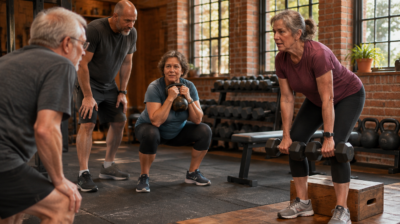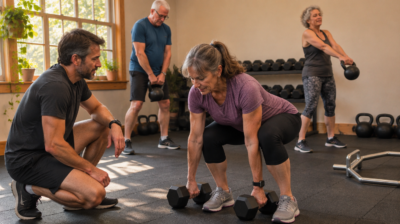
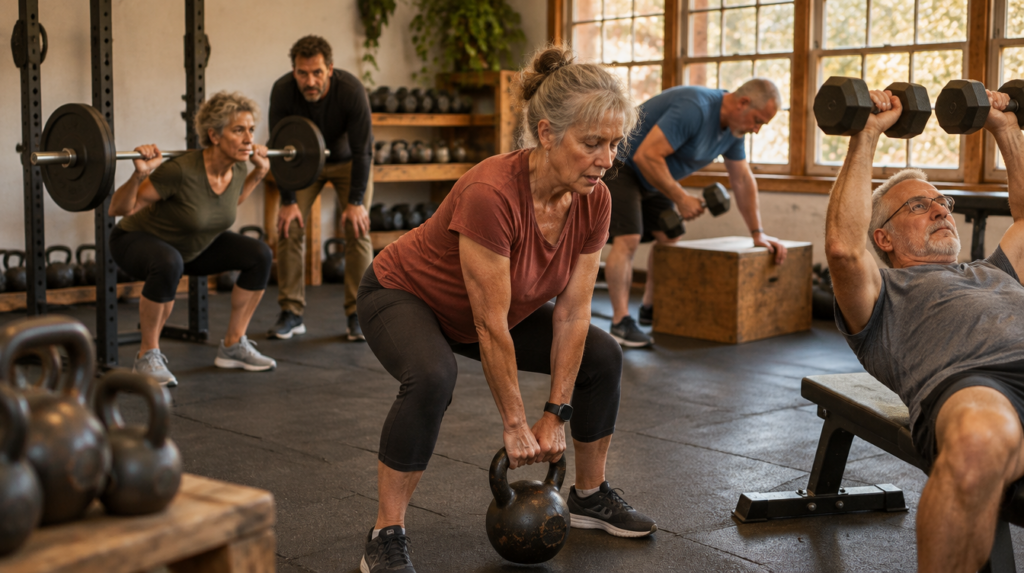
Here is what happens at your first personal training session at Inner Strength: you walk into a room with three or four other adults, a coach hands you a program written for you, and you spend most of an hour learning two or three lifts properly. There is no fitness test, no circuit built to flatten you, and nobody in the room keeping score of what you lifted.
I have had this conversation a few hundred times now. It usually happens in the doorway, coat still zipped, keys still in hand, and the question underneath it is almost never about exercise. It is some version of am I going to be the worst one in there?
So let me walk you through the room before you ever have to stand in it.
What happens at your first personal training session, minute by minute?
You check in, your coach asks how the week went and what is bothering you today, and then you start moving. The first stretch is warm-up and teaching, the middle is your lifts, and the last few minutes are whatever your body needs so you leave feeling better than you arrived.
Almost none of that hour is improvised. By the time you show up for session one, we already know how you squat, hinge, push, pull and carry, because we watched you do all of it at your Starting Point Session. Your program is printed and waiting with your name on it. Your coach has already decided which version of a deadlift you are starting with, whether you are pulling from the floor or from blocks, and what counts as a fair first ask for your shoulders.
That is the whole difference between a first session that works and one that has you walking down stairs backwards for four days. Somebody did the thinking before you got there.
Who else is in the room, and are they watching you?
Three or four other adults, most of them somewhere between forty and seventy-five, and no, they are not watching you. They are reading their own program, counting their own reps, and quietly negotiating with their own hamstrings.
This is the part almost nobody writes about, and it is the part people actually lose sleep over. A small group training room is not a class. There is no instructor on a stage, no music countdown, no moment where everyone turns to face the new person. Somebody near you is doing split squats while you are doing a carry.
What you will notice, probably in week two, is that the room is quietly friendly. Nobody asks you what you used to lift. The average age in there means most people have had a knee scoped, a back that went out at the worst possible moment, or a shoulder that has opinions about overhead pressing. You are among your own.
How many people are in a small group session?
We cap a session at eight and the real-world average is about four. One coach is on the floor for the entire hour, and every person in the room is working from their own program.
That last point is the one worth slowing down on. Everyone having their own program means your first day can be genuinely yours — goblet squats to a box while the person beside you is doing something that would hurt you this week. It also means you are never scaling down a workout that was designed for somebody else. There is nothing to keep up with.
You will also notice what is missing. There are no stack machines and no pulley machines in either studio, and that is a deliberate choice, not a budget one. Machines hold you in a fixed groove and do your balancing for you. Free weights, your own bodyweight and loaded carries make you stabilize your own joints, and that is the skill that shows up when you are carrying groceries up porch steps.
Do you have to do anything before that first session?
One thing. Everybody starts with a Starting Point Session, which is free, runs forty-five minutes to an hour, and involves no workout and no sales pitch.
You sit down, we talk about what your body used to do and what you want it doing in ten years, and then we actually look at how you move. A fifty dollar deposit holds the spot on the calendar. If you start a program, it comes straight off what you owe. If you decide we are not the right fit for you, you get it back.
What is the difference between the Starting Point Session and the Starting Point Assessment?
The Starting Point Session is the appointment. The Starting Point Assessment is what happens inside it: a movement screen plus a body composition scan.
The movement screen is me or one of our coaches watching you perform basic patterns and writing down what we see — which hip does not rotate, which shoulder shrugs up early, whether your ankle lets you squat the way your knee would like you to. The body composition scan gives us a baseline for how much muscle you are carrying, which matters more every year after fifty and is a far more useful number to track than anything on a bathroom scale.
What do you actually lift on day one?
Less weight than you are picturing, and more than you expect to enjoy. Most people spend their first session on a squat pattern, a hinge pattern, something you push or pull, and a carry.
We finish sets with reps left in the tank on purpose. Day one is a teaching day, and the goal is that you leave knowing what a good hinge feels like in your hamstrings rather than in your lower back. The loading comes, and it comes faster than most people expect once the pattern is clean — but it comes second.
Two sessions a week is where we start almost everybody, which happens to line up with the federal physical activity guidelines: the CDC recommends muscle-strengthening activity on at least two days a week for older adults, alongside aerobic work and balance work. Two honest sessions beats five sessions you resent by February.
What if you are coming back from an injury or you have just finished physical therapy?
Tell us everything, and talk to your doctor or physical therapist first. We are not a medical provider, we do not diagnose anything, and if you are mid-rehab or post-surgical we want clearance before you load a barbell.
What we are good at is the part after that. A lot of people finish their last PT appointment feeling about seventy percent of the way back, with a sheet of exercises and no plan for what happens next. That handoff is where we live, and it is why your intake asks about every surgery, every flare-up, and every movement you have quietly stopped doing. Nothing on that list disqualifies you. It just changes what your first eight weeks look like.
What should you wear and bring?
Clothes you can squat in and shoes with a flat, firm sole. Bring water, your reading glasses if you use them, and a list of anything that currently hurts.
Leave the thick cushioned running shoes in the car if you have anything flatter. They are built for running forward, not for standing stable under a weight. If running shoes are all you own, come in them anyway — nobody has ever been turned away over footwear.
How sore will you be the next day?
Mildly, in the places we worked, for about two days. Session two is almost always less sore than session one.
If you are properly wrecked after a first session, your coach got it wrong. We would rather underdose you in week one and have you walk back in on Thursday than prove a point on Tuesday and never see you again. The stiff-the-next-morning phase is shorter than almost everyone expects.
Coraopolis or Lawrence: which studio should you book?
Whichever one you will actually drive to on a cold Tuesday in February. The programming, the coaching standard, and the equipment are the same in both rooms.
Our Coraopolis studio is the easier drive if you are coming from Moon Township, Robinson, Kennedy Township, Neville Island, Sewickley or Crescent. Our Lawrence studio serves Cecil Township, Canonsburg, Bridgeville, South Fayette, Venetia and McDonald. Hours and directions for both are on our locations page.
When you are ready, book a Starting Point Session at Coraopolis or at Lawrence. Wear whatever you have on. You are not going to be the worst one in there, and after about three weeks you will stop thinking about the room at all and start thinking about the weight.