The best way to choose a personal trainer in Canonsburg is to find someone who looks at how you actually move before handing you a single exercise, writes your program around your own history instead of a class everybody does together, and already coaches people in your decade of life every day. Everything else — the square footage, the equipment wall, the playlist — matters far less than those three things.
I’m Ryan Wade, and I’ve had this conversation a few hundred times. Most weeks somebody sits down across from me at our Lawrence studio holding a folder of exercises from physical therapy, or a big-box membership they haven’t used since March, and says some version of the same sentence: “I used to be strong.” Then they brace a little, like I’m about to make them feel bad about the gap. I’m not. What I want to know is what you want to be able to do a year from now — carry a grandkid up the stairs without planning it, get through eighteen holes without your back locking up on the back nine, pick something off the garage floor and stand up like it’s nothing. That’s the job. Whoever you hire should be able to tell you out loud how the next twelve weeks connect to that.
What should a personal trainer in Canonsburg do before giving you your first exercise?
They should assess how you move, and they should do it before they program anything. If the first thing a trainer does is put you through a sweaty workout to “see where you’re at,” you’ve learned something about them and almost nothing useful about you.
At Inner Strength that first appointment is the Starting Point Session, and inside it we run the Starting Point Assessment — a movement screen plus a body composition scan. The screen is me watching you squat, hinge, step, reach overhead, and shift your weight from one leg to the other, and writing down where the motion runs out. Hips that don’t rotate. A shoulder that gets to about there and stops. An ankle that’s been stiff since a sprain in 1998 you’d forgotten about until I asked. None of that is a diagnosis and I don’t pretend it is. It’s a map of where to start and what to leave alone for now. If you want the longer version of what we look at and why, I wrote it up in strength training after 50.
Where do you train if you live in Canonsburg?
Our second studio is in Lawrence, which puts it about ten minutes from most of Canonsburg depending on which side of town you’re on. It’s a small private room, not a gym floor you have to navigate.
Which towns does the Lawrence studio serve?
Canonsburg, Houston, McDonald, Bridgeville, South Fayette, Venetia, and the Southpointe corridor — basically the whole southern end of the county, which has been underserved for this kind of coaching for a long time. Our other studio is up in Coraopolis for people on the airport side. You can see both on the locations page, and the Lawrence studio page has the hours and the schedule.
I bring up geography because proximity is the most underrated variable in this decision. A perfect gym forty minutes away loses to a good gym twelve minutes away every time, because you’ll actually go to the one that’s close. Be honest about the drive before you sign anything.
What does small group training actually look like on the floor?
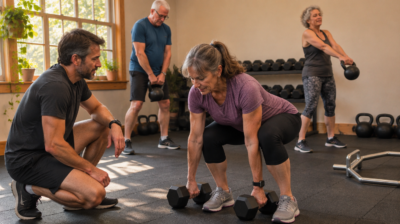
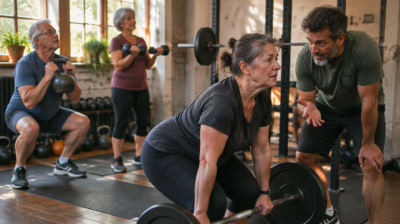
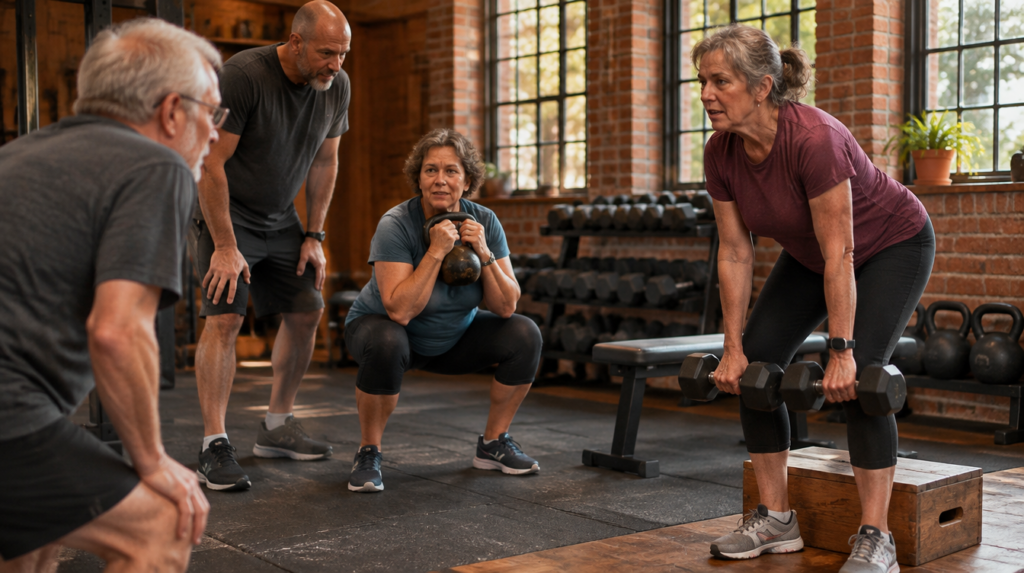
Eight people is our cap and the real average is about four, with one coach on the floor the whole hour. Everybody is on their own written program, so the person next to you is almost never doing what you’re doing.
That last part surprises people, because “small group” makes them picture a class — one instructor at the front, everyone doing burpees in unison. That’s not it. You walk in, your program is waiting with your name and your weights on it, and the coach moves between four people for sixty minutes. You’re individually programmed and individually corrected. You just aren’t paying for a private hour of somebody’s undivided attention, which is why it costs what it costs.
The other thing you’ll notice: there are no stack machines or pulley towers in either studio. Not one, and that’s deliberate. A machine holds your torso still and moves a joint for you. What you actually need is your body learning to brace, balance, and produce force standing on its own two feet. Dumbbells, kettlebells, a bar, a bench, a box, and the floor. More on how the hour runs in small group training.
How often should someone over 40 actually lift?
Twice a week, every week, covering all the major muscle groups. That’s the number that drives nearly all of the result, and the research keeps landing harder on consistency than on clever programming.
The American College of Sports Medicine updated its resistance training position stand in March 2026 — the first full rewrite in seventeen years, built from 137 systematic reviews and more than 30,000 participants. The headline finding is almost anticlimactic: training all the major muscle groups at least twice a week matters far more than chasing a perfect plan, and the single biggest jump in benefit comes from going from nothing to something.
I find that genuinely freeing to tell people. You are not behind. You don’t need to find four days a week you don’t have. Two honest hours, held for a year, will change what your body can do more than any clever program design I could sell you.
What if you just finished physical therapy?
Go back to your doctor or your physical therapist first and get cleared, then bring whatever discharge notes you have to your first session. A good coach will read them and ask questions. Anyone who waves them off is telling you something.
This is the gap I see most often around here. Physical therapy ends because the insurance says it ends, usually right about the point where the pain is gone but the strength isn’t back yet. People get handed a sheet of band exercises, do them in the basement for three weeks, and stall out. Picking the thread up from there, with the surgeon’s or therapist’s restrictions respected, is a big part of what we do. It isn’t treatment and it isn’t medical care, and anything still painful or undiagnosed belongs with a clinician, not a coach. If your situation involves a back, read how to lift safely after a back injury before you book anything, here or anywhere else.
What should you ask before you hand over a credit card?
Ask three things: what does your assessment include, how many people will be on the floor with me, and what happens if something hurts. Those three answers tell you nearly everything.
A few more worth keeping in your pocket. Who writes the program — the coach standing in front of me, or an app? What are the credentials behind the name, and are they current? (Mine are NSCA-CSCS and CPPS, and I’ll happily show you.) What’s the typical age in the room at nine on a Tuesday morning? If a studio gets vague on that last one, it usually means you’d be the oldest person there by fifteen years, and that is a miserable way to start something new.
And ask what happens when you miss three weeks, because you will. Life does that. The answer should be a shrug and a plan, not a penalty.
What happens at a Starting Point Session?
You sit down, we talk, we run the Starting Point Assessment, and you leave with a clear picture of where you’re starting and what the first twelve weeks would look like. It takes 45 minutes to an hour, it’s free, there’s no workout, and there’s no pitch at the end.
I mean that literally. You will not break a sweat, and nobody is going to ask you to decide anything on the spot. We hold the spot with a $50 deposit, which comes straight off your program if you start with us and gets refunded if you decide we’re not the right fit. The deposit exists because that’s a real hour on a coach’s calendar.
If you’re in Canonsburg, Houston, McDonald, or anywhere in the southern end of the county, book at the Lawrence studio. If you’re closer to the airport side, book at Coraopolis. Either way, come as you are. Nobody here is grading the version of you who walks in the door. We’re interested in the one who walks out a year from now.
Keep reading
- Strength Training After 50 — what changes, what doesn’t, and where to start.
- How to Lift Safely After a Back Injury — getting back to the bar without reinjuring yourself.
- Small Group Personal Training in Coraopolis, PA — the same format on the north side of the county.