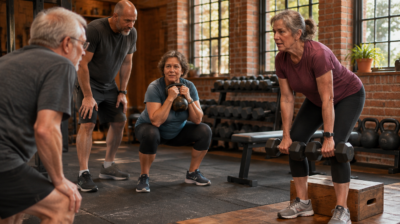
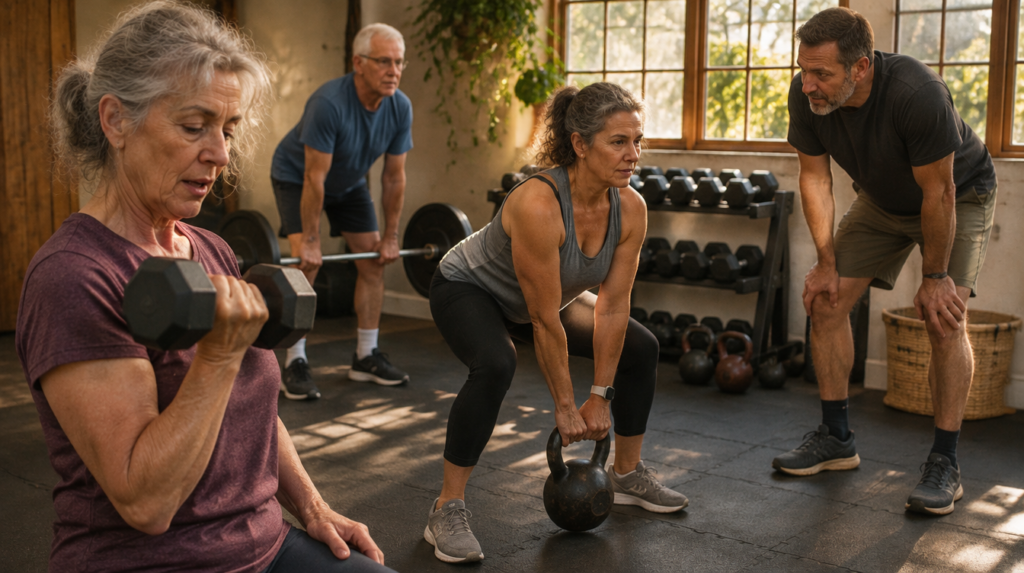
The real benefits of small group training after 40 come down to four things: you train on a program written for your body, a coach stands on the floor and watches you do it, the room caps at eight people, and you pay a fraction of what one-on-one costs. You get coached like it is private training, in a room with a few other adults who are in the same boat.
Here is the part nobody puts in the brochure. Almost everybody who walks in for the first time says a version of the same sentence within ninety seconds of shaking my hand: I just don’t want to be the worst one in there. I have heard it from people who used to be athletes and have the knees to prove it, and from people who have not picked up a weight since high school. That sentence, not money and not schedule, is the real thing standing between most adults and a barbell. It is the picture in their head of a room where everyone already knows what they are doing and the music is too loud to ask.
So let me tell you what that room is actually like.
What is small group training, exactly?
Small group training is personal training with a handful of other people in the room at the same time. One coach, a few adults, and — the way we run small group training at Inner Strength — a separate written program for every person on the floor.
That last part is where we quietly differ from most of what you will read on this topic. In plenty of gyms, “small group” means eight people doing an identical circuit at an identical tempo, which is really a class with a smaller headcount. If the sixty-year-old with the replaced hip is doing the same jump squats as the forty-two-year-old former college catcher, somebody is being underserved and somebody is being put at risk. Probably both. We write the program per person, and the group is simply who trains at that hour.
What are the benefits of small group training after 40?
The benefits of small group training stack up fastest after 40, because this is the age where generic programming stops working. You arrive with a history — an old back, a shoulder that clicks, two decades at a desk — and a program has to account for that history or it will find it for you.
1. You get your own program, not the group’s workout
Everyone on our floor is working off their own sheet. Your warm-up, your lifts, your loads, your progressions, built off what we saw in your assessment.
Practically, that means the person next to you might be deadlifting from the floor while you pull from blocks because your hips are not there yet, and neither of you has to feel odd about it. Nobody is scaling down in public, because there is no shared workout to scale down from. Over a few months this is the whole ballgame — progress after 40 comes from the right dose applied patiently, not from surviving the hardest thing in the room.
2. There is a coach on the floor for the whole hour
One coach, eyes up, the entire session. Not a coach who sets a timer and then answers emails at the desk.
This is the piece people underestimate until they have had it. Technique drifts under fatigue — that is not a character flaw, it is just what happens to a hinge pattern on the fifth set. Having somebody catch the drift on rep four instead of rep nine is the difference between training for twenty years and taking six weeks off every spring. It is also how you learn to train yourself, which is honestly the goal.
3. Eight people maximum, and usually about four
Our rooms cap at eight. On an average session there are about four people on the floor.
Eight is the ceiling, not the target, and four is what it looks like most hours. At that size the coach knows your name, your history, and the fact that your left shoulder is cranky on Mondays. The room is also quiet enough to hold a conversation, which matters more than it sounds. And you will notice something about our floor: no stack machines, no pulley towers, no circuit of chrome seats. That is deliberate. Barbells, dumbbells, kettlebells and the ability to put your body in positions you actually use — getting off the floor, carrying groceries, lifting a bag into an overhead bin.
4. It costs less than one-on-one without feeling like a class
Splitting a coach’s hour across a few people brings the price down meaningfully compared with private training. The coaching does not get diluted the way it would in a room of thirty.
I will not pretend cost is irrelevant — it is the second thing people ask about. For most adults the honest math is that small group buys you twice a week for the long haul instead of once a week for three months. Consistency over two years beats intensity over eight weeks every time, and the format you can afford to keep doing is the one that works.
5. You show up, because people notice when you don’t
When the same three or four people train at your hour, your absence is visible. That is accountability you cannot manufacture on your own.
Nobody is shaming anybody. It is gentler than that — somebody asks how the wedding went, or gives you grief about the Steelers. Adults over 40 do not have many standing appointments with other adults outside of work and family. A 6 a.m. Tuesday where four people expect to see you turns out to be a sturdy thing. I have watched it carry people through winters that would otherwise have ended their training.
Is small group training safe if you have a history of injuries?
For most people with an old injury that has healed, yes — that is a large share of who we train. If you are in pain right now, or still under care, that is a conversation for your doctor or physical therapist before it is a conversation with me.
I have spent years working alongside local chiropractors and physical therapists on what happens after a client is discharged, and the honest gap is this: rehab gets you out of pain, then it ends, and nobody hands you a plan for getting strong again. We can take a handoff from your PT and build from where they left you. What we will not do is diagnose or treat anything. If something needs a clinician, we will say so and help you find one.
How often should you train after 40?
Twice a week is the number that holds up. It is also what the national physical activity guidelines recommend for muscle-strengthening work, and the CDC says the same for adults 65 and older.
Two sessions a week, a day apart, is enough to add strength and keep adding it, and most people can protect that schedule for years. Three is better if your life allows. One is maintenance at best. More on how this shifts decade to decade in strength training after 50.
Where can you do this around Pittsburgh?
We run small group training at two studios. Our Coraopolis studio serves Moon Township, Robinson, Sewickley, Kennedy and Neville Island, and our Lawrence studio serves Canonsburg, Cecil, Bridgeville, South Fayette, Venetia and McDonald.
Both rooms run the same way: same cap, same individual programming, same no-machines setup. Pick whichever one is on the right side of your commute — you can see both on our locations page. The 5:30 p.m. drive decides more about whether you keep showing up than motivation ever will.
How do you start?
You book a Starting Point Session. It is free, it runs 45 minutes to an hour, there is no workout and there is no sales pitch.
Inside that appointment we do the Starting Point Assessment — a movement screen plus a body composition scan — so we can see how you actually move before anybody writes you a program. Then we talk about what you want to be able to do, and I tell you honestly whether we are the right fit. A $50 deposit holds your spot; it goes toward your program if you start, and comes back to you if you don’t. For exactly what the hour looks like, read what happens in a Starting Point Session.
Book at Coraopolis or Lawrence. And for what it’s worth — in more than a decade of doing this, nobody has ever turned out to be the worst one in the room. That person does not exist. Everybody is just working on their own sheet.