If you’ve been thinking about personal training but haven’t pulled the trigger, the thing keeping you on the fence probably isn’t the price or the schedule. It’s the not-knowing. What actually happens on a first visit? Are they going to make me do burpees to see if I’m “in shape enough”? Am I going to feel judged? Will they tell me things that scare me? What am I walking into? This article answers all of that. Here is exactly what happens at a movement assessment at Inner Strength, what you can expect, what you don’t need to worry about, and what you’ll leave with — so you can decide from a place of information instead of guessing.
| Quick answer: A movement assessment is a 45-60 minute one-on-one appointment where a coach evaluates how your body moves, identifies your specific asymmetries, restrictions, and strengths, and translates that into a plan built for you. There is no workout, no judgment, and no pressure. You leave with a clear picture of where your body is today, a written summary of what was found, and a recommendation for what the right training program would look like for you specifically. It is the foundation of every real personal training relationship — and if a coach offers to train you without doing one, that is a red flag. |
Why the assessment matters (and why so few places do it well)
A movement assessment is not a fitness test. It is not designed to judge whether you’re strong enough, in shape enough, or coordinated enough to be there. It is designed to answer three specific questions: how does your body currently move, where are the limitations that need to be respected, and what is the right starting point for your training. Without the answers to those three questions, no coach can write you a real program. They can only write the same program they wrote for everyone else, hoping it works for you too.
This is the reason so much fitness advice fails adults over 40. Most programs are written for a generic body — young, healthy, no injury history, symmetrical, uninjured. That body doesn’t exist in your demographic. Every adult past 40 has movement history: old sports injuries, decades of desk work, joints that don’t sit exactly where they used to, one shoulder that moves differently from the other, one hip that’s been quietly compensating for years. A generic program either loads those imbalances until something breaks, or works around them so gently that nothing actually changes. The assessment is what makes the difference — it tells the coach what your body actually needs before a single exercise is chosen.
What the assessment is not
Before walking through what happens, it’s worth being clear about what does not happen. This is the part most people are quietly worried about, and it doesn’t get said out loud enough:
- You are not asked to “prove” you belong there. No sprinting, no burpees, no maximum lifts, no cardiovascular tests you’d have to explain later.
- You are not weighed unless you specifically want to be. This is not a body composition analysis. It is a movement analysis. Numbers on a scale are irrelevant to what we’re looking at.
- You are not put through anything painful. If a movement causes discomfort, we stop, note it, and move on. The point of the assessment is to find restrictions, not to push through them.
- You are not judged. There is no version of your body that we haven’t seen before. Whatever you’re worried about — being out of shape, being inflexible, being embarrassed by an old injury pattern — none of it registers as unusual. It registers as information.
- You are not pressured into signing up. The assessment is a standalone conversation. You can walk out of it with the information and think about it. Most people do.
If any personal trainer or gym does any of the things on this list during a first visit, that’s a signal to try somewhere else. The purpose of a real assessment is to inform, not to sell, and not to test.
What actually happens, step by step
Here is the actual sequence of an assessment at Inner Strength, from the moment you arrive to the moment you leave. Total time: 45-60 minutes, depending on how much conversation is useful.
Step 1: The intake conversation (10-15 minutes)
We sit down and talk before any movement happens. This is not paperwork disguised as small talk — it’s the most important part of the whole session. We ask about your history in a specific way: what your body has been through, what sports or activities you did over the years, what injuries have happened (even ones you consider “minor” or “a long time ago”), what surgeries you’ve had, what medications affect how you move, and what daily activities are getting harder or easier.
We also ask what you actually want. Not the fitness-industry version of a goal (“I want to lose 20 pounds”) but the real one underneath it (“I want to feel like myself again,” “I want to keep up with my kids,” “I want my back to stop hurting when I get out of the car”). The stated goal and the real goal are often different things, and the training only works if we’re aiming at the right one.
The intake also includes what you’ve already tried. What has and hasn’t worked, what other gyms or programs you’ve been part of, what your current routine looks like. Most adults over 40 walk in with a decade of trial and error already accumulated. That history is enormously useful — it tells us what to skip.
Step 2: The standing assessment (5-10 minutes)
You stand in a neutral position — normal posture, arms at your sides — and we look at how your body stacks. What we’re looking for is not “good” or “bad” posture. We’re looking for asymmetries: whether one shoulder sits higher than the other, whether the pelvis is rotated, whether the head sits forward, whether the arches of your feet look different from side to side. These are not aesthetic observations. They are structural clues about how the body distributes load and which muscles are working too hard while others are asleep.
This is done fully clothed. Nothing invasive. Most of what we’re looking for is visible from across the room. You’re not on display — you’re just standing while a trained eye takes notes.
Step 3: The functional movement screen (15-20 minutes)
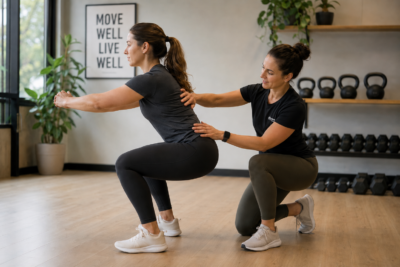
This is the core of the assessment. We ask you to perform a specific set of basic movements — the kind of movements your daily life requires. The exact set is calibrated to your history, but the standard screen covers a squat pattern, a lunge or single-leg pattern, a hip hinge, a shoulder mobility check, an overhead reach, an ankle mobility check, a rotational movement, and a balance test.
None of these are heavy. Most of them use bodyweight, a light stick, or your own hands. What we’re measuring is not strength — it’s how the movements happen. Does the knee track over the toe or fall inward? Does the low back arch when the arms go overhead? Does one side of the body move differently from the other? Is the pattern smooth or does the body substitute something else because the primary muscles aren’t firing? A trained coach can see all of that in real time. You will not feel like you’re being scrutinized. You’ll feel like you’re just doing some simple movements. But every one of them is generating information.
If a movement causes pain, we stop and note it. Pain is a piece of data, not a failure. We move on to the next movement without judgment.
Step 4: The specific tests (5-10 minutes)
Based on what shows up in the general screen, we run more targeted tests for whatever patterns need clarification. If your squat looked compromised, we look specifically at hip mobility and ankle mobility to figure out which is the limiting factor. If your shoulder mobility was restricted, we check thoracic spine mobility and scapular stability to identify the source. If your balance was off, we test single-leg stance and foot proprioception.
These targeted tests are what turn a general screen into an actual diagnosis. Without them, we’d know something is off but not why. With them, we know exactly what to train first — because we know exactly what’s causing what.
Step 5: The debrief and recommendation (10-15 minutes)
We sit down again and walk you through what we found. In plain English. No jargon that only makes sense to us, no fear tactics about how broken your body is, no vague reassurance either. You get an honest picture: here’s what your body is doing well, here’s what needs work, here’s what’s likely causing any pain patterns you mentioned in the intake, here’s the priority order of what to address first.
Then the recommendation. Based on everything we’ve seen, here is what the right training program would look like for you. What days, what frequency, what pattern of exercises, what the timeline is to feel different, and what specific outcomes to expect. Sometimes the recommendation is our program. Sometimes the honest recommendation is that you need to see a physical therapist first, or a physician, or a specialist, and we tell you so. The point of the assessment is to give you the right next step, not to guarantee that next step is us.
What you leave with
Every client leaves the assessment with three specific things, in writing:
- A written summary of what we found
This is a paper (or digital) document that lists your assessment findings by joint and by pattern. It says, for example, “limited internal rotation in the right hip, likely contributing to the reported low back pain,” or “asymmetrical single-leg balance, right side significantly weaker than left, contributes to reported knee pain.” This document is yours to keep, share with your physician or physical therapist if relevant, and reference against future re-assessments to measure change.
- A recommended program structure
A specific answer to the question “what would training actually look like for me?” Not a generic template — a plan built from your specific findings. This is the blueprint you’d be starting from if we worked together, and if we don’t, you can take it to any competent coach elsewhere and they can execute against it.
- A clear picture of the timeline
Realistic expectations for when things start to feel different. For most adults over 40 addressing chronic patterns, the milestones are: noticeable change in energy and daily comfort within 3-4 weeks, measurable improvements in movement quality within 6-8 weeks, real strength gains and pattern rebuilds within 12-16 weeks. The timeline varies by starting point, but you walk out knowing what to expect at each phase — not sold on a fantasy of dramatic results in three weeks.
THE CORE REASON THE ASSESSMENT MATTERS
|
How our assessment differs from what most gyms do
It’s worth being direct here, because “we do a consultation” gets used to mean a lot of different things across the fitness industry. Some of those things are meaningful. Most are not. Here is how the standard varies:
The five-minute sales pitch disguised as a consultation
Common at big-box gyms. A “trainer” (often a salesperson with a certification) meets with you for ten minutes, asks about goals, quotes package prices, and pressures you into signing that day. There is no movement analysis. There is no plan. The consultation is a sales funnel with a lab-coat costume. If you walk in and there’s a whiteboard with package prices on it before anyone has watched you move, that’s what you’re in.
The single-test screen
Common at smaller gyms and some franchise chains. A coach has you perform one or two movements (often just an overhead squat and a lunge), scores them on a rubric, and produces a report. This is better than nothing, but a two-movement screen catches only a fraction of what a full assessment would find. It’s the difference between a strep test and a full physical.
The bodyweight workout as “assessment”
Some studios market a first-session workout as an assessment. They put you through a scaled version of their normal class, watch you, and call it evaluation. The problem: your body is fatigued from the workout by the end, so any “assessment findings” reflect exhausted movement patterns, not your true baseline. Plus, they didn’t diagnose anything — they just watched you exercise.
The full assessment (what we do)
What this article describes. A structured, fatigue-free session focused entirely on movement analysis, with a written debrief and a specific recommended plan. The client leaves with actual information. This is what a real medical or physical-therapy-adjacent process looks like — because that’s the standard rehab-informed coaching is drawn from.
What if the assessment reveals something serious?
| It sometimes does, and when it does, our job is to say so clearly and refer you to the right professional. Movement assessment is not medical diagnosis. If we see something that looks structural (a possible disc issue, a possible tear, a possible neurological pattern), we tell you and recommend you see a physician or physical therapist before beginning strength work. This is not us covering ourselves — it’s us being honest that our scope has limits. The distinction between “restriction” and “injury” is where a lot of coaches overreach, and we don’t. |
The good news is that this happens less often than most adults fear. The vast majority of what shows up in assessments is normal age-related pattern breakdown — the kind of thing that responds beautifully to intelligent programming and doesn’t need medical intervention. But when something clinical does show up, you’ll know, you’ll know exactly what to do about it, and you won’t be pressured to keep training with us until you’ve addressed it appropriately.
How to prepare for the assessment
Very little preparation is needed, but a few things help:
- Wear clothes you can move in comfortably. Athletic wear is fine but not required — anything that lets you squat and reach overhead without restriction works.
- Bring a list of any current medications, past surgeries, and injuries you can remember — even old ones you consider “nothing.” A shoulder dislocation in college matters at 55.
- Come with your real goals in mind, not the ones you think you’re supposed to have. If you want to keep up with your kids, say that. If your back hurts when you get out of the car, say that. Specific, honest goals produce specific, useful plans.
- If you have imaging (MRI reports, x-rays) related to past injuries, bring copies. We’re not diagnosing from them, but they help us understand what to work around.
- Eat like you normally would beforehand. This isn’t a fasted test.
Everything else, we handle.
How to book an assessment at Inner Strength
Assessments are available at both of our Pittsburgh-area studios. They are booked directly through our website or by calling either location. Turnaround from booking to first appointment is usually within a week.
Coraopolis studio (airport corridor)
Serves Coraopolis, Moon Township, Robinson Township, Kennedy Township, Sewickley, Neville Island, Crescent, and Glen Osborne.
Lawrence studio (South Hills)
Serves Bridgeville, Upper St. Clair, Peters Township, McMurray, Canonsburg, South Fayette, Scott Township, Mt. Lebanon, and Bethel Park.
Our coaches hold credentials including NSCA-CSCS, NASM-CPT, NASM Nutrition Specialist, CPPS, and ACE certifications. Every assessment is conducted by a certified coach, not a salesperson.
Frequently asked questions
How much does the assessment cost?
Consultations and initial movement assessments are complimentary at Inner Strength. We don’t gate the assessment behind a fee because we believe the information belongs to you regardless of whether you decide to train with us. Pricing for training programs is discussed after the assessment, when we can quote something specific to what your plan requires.
How long does the assessment take?
Plan for 30-45 minutes total. Some assessments run shorter if the picture is clear early. Some run longer if the conversation goes in useful directions. We don’t rush you out at 45 minutes if there’s more to talk about, and we don’t drag it out artificially either.
Do I need to be “in shape” to have an assessment?
No. In fact, the assessment is arguably more valuable for adults who haven’t been training. If you’ve been sedentary for years, if you’ve had injuries you never fully rehabbed, or if you’ve never trained with a coach before, the assessment reveals exactly what you need to know before starting. There is no fitness prerequisite.
What if I have chronic pain?
Chronic pain is one of the most useful things to bring into an assessment. Most chronic pain patterns in adults over 40 are movement-related and traceable to specific upstream causes — see our blog on the seven pain myths for the full breakdown. The assessment is often where clients get their first clear explanation of what’s actually causing pain they’ve had for years.
Can my spouse come to the assessment?
Yes, and many couples come in together — either both getting assessed the same day (separate sessions) or one supporting the other. There is no additional cost for having someone with you, and some clients find it easier to remember what was said afterward if a second person heard it too.
Which Inner Strength studio should I book?
Whichever is closer to home or work. Our Coraopolis studio serves the airport-corridor communities (Moon, Robinson, Kennedy, Sewickley, Neville Island, Crescent, Glen Osborne). Our Lawrence studio serves the South Hills (Bridgeville, Upper St. Clair, Peters Township, McMurray, Canonsburg, South Fayette, Mt. Lebanon, Bethel Park). The methodology and coach credentials are the same at both.
What if I get the assessment and decide not to train with you?
That’s completely fine and happens regularly. You walk out with your written summary and recommended plan, and you’re free to take it wherever you like — another coach, a physical therapist, or your own solo routine. The assessment itself is the deliverable; the training relationship is separate. We’d rather send you somewhere else with good information than have you train with us because you felt cornered.
| You shouldn’t have to guess what you’re walking into.
Inner Strength Personal Training offers complimentary movement assessments at both our Coraopolis (airport corridor) and Lawrence (South Hills) studios. No workout, no judgment, no pressure — just a clear picture of where your body is and what a real plan would look like. Book at InnerStrengthPGH.com or call the location nearest you. |