Rehab-Informed Strength Training: Why It Matters for Adults Over 40 | Inner Strength Personal Training
If you are over 40, there is a good chance your body has a history. A surgery five years ago. A back that gets cranky if you lift wrong. A shoulder you have stopped trusting overhead. A knee that complains on the stairs. These are not reasons to avoid strength training. They are reasons to be coached differently than someone with a blank-slate body. That is what rehab-informed strength training is, and it is one of the most important things to understand if you want to get strong safely after 40.
| Quick answer: Rehab-informed strength training is a coaching approach that brings the assessment lens, progression principles, and corrective-exercise toolkit from physical therapy into a strength training program. It is not physical therapy, and it does not replace your PT. It is what happens after PT, or alongside good medical care, when you want to build real strength without aggravating old injuries. At Inner Strength Personal Training, this is the methodology we use with every adult over 40 at both our Coraopolis and Lawrence studios, serving the airport corridor and the South Hills. |
What is rehab-informed strength training?
Rehab-informed strength training is a methodology, not a specific workout. It describes how a coach thinks about your body before they ever load you up, and how they make decisions session to session as your training progresses.
A coach trained in this approach borrows directly from the world of physical therapy and corrective exercise. Three principles in particular shape every session:
- Assess before you load. Movement quality, injury history, and current pain are mapped before any meaningful weight goes on the bar. You do not get a program off a shelf; you get a program built from what your body actually does today.
- Train the joint before you train the lift. If a movement pattern is broken, the priority is restoring it, not grinding through it heavier. A coach with this lens sees a faulty squat and adds mobility and stability work before adding load.
- Progress like a clinician. Increases in difficulty are deliberate and tracked. The question is never “how much can you handle today” but “what is the smallest meaningful progression from last session.” That patience is what protects the jointover years, not just weeks.
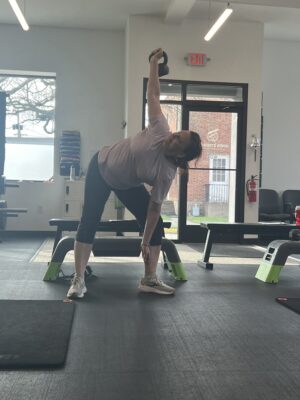
This is the opposite of how most adults get trained. Walk into a typical gym and you get a generic program, no assessment, and a trainer pushing you to PR. Walk into a typical group fitness class and you get a workout designed for the average person in the room, which is almost never you. Rehab-informed coaching starts somewhere else entirely: with the specific body in front of the coach.
How is it different from physical therapy?
| Physical therapy is medical treatment for an injury or condition, delivered by a licensed PT and typically covered by insurance for a defined episode of care. Rehab-informed strength training is fitness coaching that uses PT principles to build long-term strength in a body that has a history. PT solves a specific problem; rehab-informed training prevents the next one and builds capacity. They are complementary, not competitive. |
The clearest way to see the difference is to follow a hypothetical client through their year.
January: an injury or flare-up
You tweak your back lifting something the wrong way. You see a physical therapist. They diagnose the issue, treat the inflammation, restore your range of motion, and give you exercises to do at home. After six to ten weeks, they discharge you.
March: discharged, but now what?
This is the gap most people fall into. Your PT discharged you because the immediate problem is resolved, but you are not strong. The muscles that protect your spine atrophied during the flare-up. The strength you had a year ago is gone. And the gym is intimidating, because the last thing you did at a gym is what hurt you in the first place.
April through December: rehab-informed strength training
A rehab-informed coach picks up where your PT left off. They see your assessment notes, they understand the limitation, and they build a strength program that respects the history without being paralyzed by it. Over the year, you do not just return to where you were before the injury. You become measurably stronger, and the surrounding muscles do their job better, which makes the next flare-up less likely or less severe.
This is the bridge. Without it, most adults either avoid strength training entirely after a setback, or they jump back into something generic and end up injured again. The bridge is what gets you to the other side.
Key takeaways
|
Why does this matter more after 40?
Three things change after 40 that make rehab-informed coaching disproportionately valuable.
Your history is longer
By 40, most adults have accumulated a real injury history. Old surgeries. Years of desk work. A back from one car accident, a knee from one weekend warrior incident, a shoulder from years of bad sleeping position. None of this is a problem for training, but it changes how training should be structured. A coach without this lens trains every body the same, which is fine for an unmarked 22-year-old and risky for a 52-year-old.
Recovery slows down
In your 20s, you could push through a bad rep or a poorly designed program and your body would forgive you. After 40, the margin for error shrinks. Recovery takes longer, soft tissue is less elastic, and a small training mistake can sideline you for weeks. Rehab-informed coaching is built around respecting that smaller margin. The principle is simple: never trade short-term progress for long-term setback.
The stakes are higher
Strength training in your 20s is mostly about looking and feeling a certain way. After 40, it becomes about whether you can keep doing the things you love for the next thirty or forty years. Your knees on a hike with your grandkids. Your back lifting a kayak onto the car. Your shoulders carrying luggage through an airport. The stakes are no longer cosmetic. They are about the kind of life you get to have, and one ill-advised training injury can quietly close doors you never planned to close.
That raised stakes is why coaching matters more after 40, not less. A 25-year-old can teach themselves to lift from YouTube and probably be fine. A 55-year-old with three old injuries cannot, and trying to is one of the most common ways adults get permanently scared off strength training.
What does a rehab-informed session actually look like?
On the surface, a session looks like normal strength training. You are still hinging, squatting, pressing, pulling, and carrying. What is different is what is happening underneath the workout, the coaching layer that is invisible to anyone watching.
It starts with a real assessment
Before your first real session at Inner Strength, you go through a full movement screen. We look at how you move, where you are restricted, where you are weak, what hurts, and what feels strong. Your program is built from those findings, not pulled from a template.
Warm-ups are corrective, not just preparation
In a generic workout the warm-up is a brisk five minutes to get your heart rate up. In a rehab-informed session the warm-up is targeted, addressing the specific mobility and stability gaps your assessment revealed. If your right hip is tight, your warm-up works that hip. If your thoracic spine is locked up, your warm-up unlocks it. Every minute serves the body in front of the coach.
Exercise selection respects your body
If a traditional back squat aggravates your knee but a goblet squat to a box feels strong and stable, we build from the goblet squat. The principle is to find the version of each movement pattern your body does well today, then expand from there. We never force a body into an exercise; we adapt the exercise to the body.
Progression is patient and tracked
Load increases are deliberate. We track what you did last session and decide together what makes sense for today, based on how you are recovering, how the assessment data is shifting, and how the movement looks. The goal is consistent forward progress over months and years, not impressive lifts this week followed by a setback next week.
The coach watches the joint, not just the rep
In a generic group setting, the instructor counts reps and watches the room. A rehab-informed coach watches your specific joint, the one with the history, and is ready to adjust the moment something looks off. This single difference, having an attentive, trained eye on your particular vulnerability, is the single biggest reason injuries stay rare in this kind of coaching.
Who is this approach right for?
Rehab-informed strength training is the best fit for several specific situations:
- You have completed physical therapy and you want to build real strength without the intimidating jump straight to a generic gym program
- You have a chronic concern (back, knee, hip, shoulder) and have been told to exercise but are not sure what is safe
- You have an old injury that has healed but still influences how you move, and you want a coach who notices and adjusts
- You are recovering from a joint replacement or significant surgery and your surgeon has cleared you for strength training
- You have been afraid of lifting weights because of something that happened years ago, and you want guidance that respects that history
- You have never been injured, but you are over 40 and you would rather train smart from the start than learn the hard way
In short, if your body has a history, or you would prefer to keep it that way, this is the approach you want.
Where can I find rehab-informed strength training near me?
Inner Strength Personal Training has built its entire methodology around this approach for adults over 40. We operate two studios across the Pittsburgh area, so this kind of coaching is accessible whether you live in the airport corridor or the South Hills.
Coraopolis studio (airport corridor)
Serves Coraopolis, Moon Township, Robinson Township, Kennedy Township, Sewickley, Neville Island, Crescent, and Glen Osborne. If you are looking for a personal trainer who works with physical therapy referrals or post-rehab clients near the airport corridor, this is your closest option.
Lawrence studio (South Hills)
Serves the South Hills and neighboring Washington County communities, including Bridgeville, Upper St. Clair, Peters Township, McMurray, Canonsburg, South Fayette, Scott Township, Mt. Lebanon, and Bethel Park. If you are looking for rehab-informed coaching near Bridgeville, Upper St. Clair, or Peters Township, the Lawrence studio offers the same methodology and the same certified team.
Our coaches hold credentials including NSCA-CSCS, NASM-CPT, NASM Nutrition Specialist, CPPS, and ACE certifications, and they have years of experience coaching adults with real injury histories. We have trained clients with back issues, joint replacements, balance challenges, spinal cord stimulators, and clients who simply have not lifted a weight in twenty years. We meet you where you are.
Frequently asked questions
Is rehab-informed strength training the same as physical therapy?
No. Physical therapy is medical treatment delivered by a licensed PT for a specific injury or condition. Rehab-informed strength training is fitness coaching that uses PT principles to build long-term strength in a body that has a history. We do not diagnose or treat injuries. We coach strength training in a way that respects the history your body is carrying.
Can I start before I am done with physical therapy?
Sometimes, with your PT’s blessing. We are happy to coordinate with your physical therapist so the strength work we are doing complements rather than conflicts with what they are doing. More commonly, clients start with us after they have been discharged from PT and want to build on the foundation that was laid.
I do not have a current injury, just an old one. Is this approach still right for me?
Yes. Old injuries influence how you move long after the original problem has healed, and a coach with this lens notices things a generic trainer would miss. This approach is also smart for adults over 40 who simply want to train intelligently from the start and avoid becoming the next injury story.
Do you work with referrals from physical therapists or doctors?
Yes, regularly. Several local physical therapists and physicians refer clients to us specifically because they trust how we handle the transition from clinical care to long-term fitness. If your PT or doctor wants to send notes or speak with us, we welcome that.
How is this different from just having a careful personal trainer?
Care alone is not enough. A trainer who is careful but lacks the assessment lens and corrective-exercise toolkit may still write programs that quietly aggravate old issues. Rehab-informed coaching is a specific methodology: assess first, train movement quality before adding load, progress like a clinician, and keep eyes on the vulnerable joint every session. It is care plus method.
Which Inner Strength location is closest to me?
Our Coraopolis studio serves the airport-corridor communities including Moon Township, Robinson, Kennedy, Sewickley, and Glen Osborne. Our Lawrence studio serves the South Hills, including Bridgeville, Upper St. Clair, Peters Township, McMurray, Canonsburg, South Fayette, Mt. Lebanon, and Bethel Park. Most clients pick the studio closest to home or work.
| Your body has a history. Let us train it the way it deserves.
Inner Strength Personal Training offers rehab-informed strength training for adults over 40 across the Pittsburgh area, from Coraopolis and Moon Township to Bridgeville, Upper St. Clair, and Peters Township. Every new client starts with a free consultation and a full movement assessment, so the plan we build is yours, not a template. Book at InnerStrengthPGH.com. |