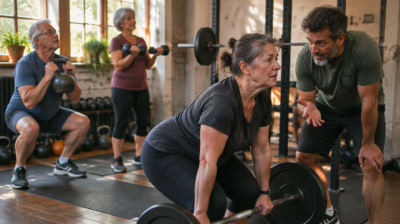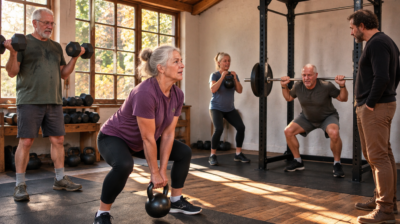
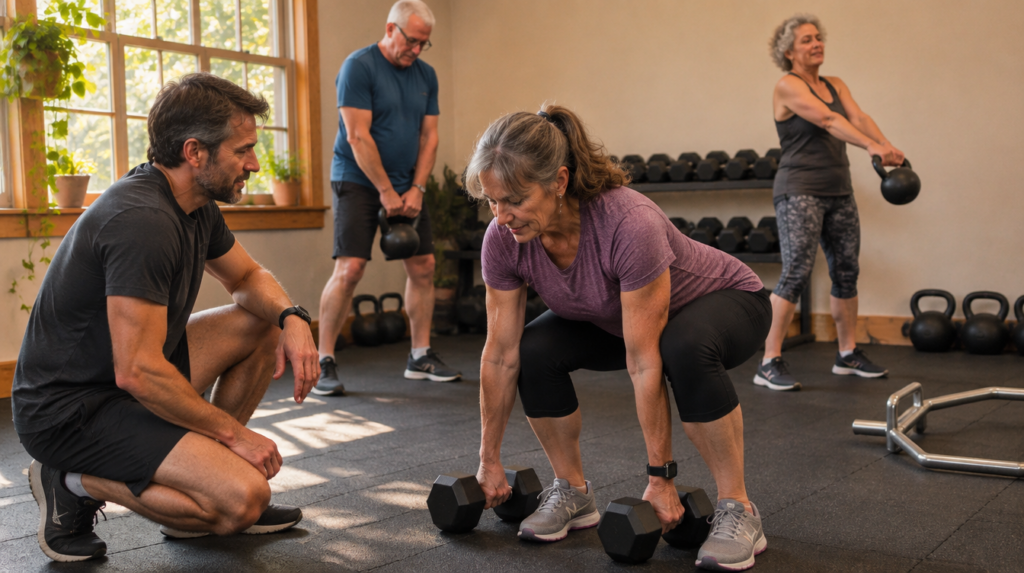
If you are weighing small group vs personal training, here is the honest answer before I talk your ear off: for most adults over 40, small group is the better fit, because the thing that actually changes your body is showing up twice a week for a couple of years, and a room with four other people in it makes that far easier to keep doing. One-on-one is the right call when something about your situation needs a coach’s hands and eyes on every single repetition — a fresh injury, a recent surgery, a movement you are not ready to load without someone standing two feet away.
I have had this conversation a few hundred times, almost always in the same spot. Somebody is standing just inside the door at our Coraopolis studio, coat still on, watching a group finish a set of trap bar deadlifts, and they say some version of: “I think I need the private thing. I don’t want to hold anybody up.” Then they watch for another minute and notice that the four people on the floor are all doing completely different exercises, at completely different weights, and nobody is holding anybody up because there is no line to hold up. That is usually the moment the question changes from which one do I need to when can I start.
Small group vs personal training: what is actually different?
The difference is not the coaching quality or how individual your program is — in a well-run room, both are the same. The difference is how many other people are getting that same attention in the same hour, and what that does to the price and to the feel of the room.
Most articles on this will tell you one-on-one means a tailored program and group means everybody does the same circuit. That is true at a lot of places, and worth checking before you sign anything anywhere. But it describes how most gyms run groups, not a law of physics. At Inner Strength’s small group training, every person on the floor is on their own written program, built from their own assessment, progressed on their own timeline. Two people might be in the same hour for two years and never do the same session. The coach is not leading a class from the front. They are working the floor, which is a different job entirely.
So when you are comparing options, the question to ask is not “group or private.” It is “is everyone in that room on their own program, or is everyone doing today’s workout?” Those are two wildly different products that get sold under the same words.
How many people are actually in the room?
Our groups cap at eight and average about four. One coach is on the floor the entire hour, and there is no stack machine or pulley system anywhere in either building, by design.
That last part surprises people. Machines fix your body into a path somebody else picked, which is handy if you want twenty people moving through a facility quickly, and much less handy if you are 58 and your right shoulder does not travel the same arc as your left. Free weights, trap bars, sleds, and your own bodyweight let the movement fit the person, and the coach spends the hour reading real movement instead of adjusting seat heights.
Is small group training as effective as one-on-one?
For nearly every goal an adult over 40 walks in with — getting off the floor without furniture, carrying groceries without a flare-up, keeping up on a hike in the Laurel Highlands — yes. The deciding factor is not the ratio in the room, it is whether your program is actually written for you and whether you are still doing it in eighteen months.
I want to be careful here, because this is where fitness marketing usually goes sideways. Nobody has ever gotten stronger from the perfect program they quit in March. The federal physical activity guidance for older adults asks for muscle-strengthening work on at least two days a week, every week, plus balance work — and the honest obstacle for most people is not knowing that, it is stringing those weeks together for years. A standing Tuesday and Thursday at 9 a.m. with four people who notice when you are not there does that better than almost anything else I have found in twelve years of running this business.
There is a second thing that nobody writes about, and I think it matters more than the cost comparison. In a group, you watch other people train. You see the woman who had a knee replaced in February deadlift in October. You watch a 71-year-old go through a set you were nervous about last month. You cannot buy that in a private session, and for a lot of people it is the whole ballgame — it quietly rewrites what they think is possible for a body their age.
Who should choose one-on-one personal training?
Choose one-on-one if you are inside the first weeks after a surgery or an acute injury, if you have a condition where a coach needs to watch every rep and adjust mid-set, or if the idea of other people in the room is genuinely the thing stopping you from starting at all. That last one counts, and I will never argue someone out of it.
Scheduling is the other real reason. If your work travel is unpredictable and a fixed Tuesday and Thursday is fantasy, private sessions bend around your calendar in a way a group hour cannot. That is logistics, not principle.
What if I am coming out of physical therapy?
This is the most common version of the question we get, and the plain answer is that it depends on where your discharge left you. If you are still under a therapist’s or physician’s care, or still have restrictions on your paperwork, that conversation happens with them first — we are coaches, not clinicians, and we do not diagnose or treat anything.
What we do is the part that comes after. Most people finish PT having gotten the pain down and the basic function back, and then get handed a photocopied sheet of exercises and a handshake, which is a terrible way to spend the next thirty years. Picking that up and progressing it is exactly what the group floor is built for — everyone is on an individual program anyway, so an entry that respects a surgical history is normal rather than special. If your situation involves your back specifically, I wrote more about how we handle that in lifting safely after a back injury.
What does this look like in Coraopolis and Lawrence?
We run both studios the same way, with the same cap of eight, the same individual programming, and the same equipment philosophy. The Coraopolis studio draws most of its people from Moon Township, Robinson, Sewickley, Kennedy, and the airport corridor — the kind of drive where you talk yourself out of it if it is longer than fifteen minutes, which is exactly why having two locations mattered to us.
The Lawrence studio covers the southern side: Canonsburg, Cecil, Bridgeville, South Fayette, McDonald, and Venetia. Same room, same standard, different parking lot. If you are not sure which is closer in practice rather than on a map, our locations page has both addresses and hours.
How do I find out which one fits me?
Come in for a Starting Point Session and we will tell you honestly, including when the honest answer is “not us.” It is free, runs 45 minutes to an hour, and there is no workout and no sales pitch in it.
Here is what happens. We sit down and you tell me what you are trying to get back to — the specific thing, not the generic version. Then we run the Starting Point Assessment, which is a movement screen plus a body composition scan, and the screen is the part that answers your question. If what we see needs a coach’s hands on every rep for a while, I will say so — I would rather lose the group sale than put you somewhere you are not ready for. If it does not, you will know that too, with reasons attached instead of a vibe. I walked through the whole appointment in detail in this post about the Starting Point Session.
There is a $50 deposit to hold the spot. It goes toward your program if you start with us and comes back if you decide we are not the right fit — the hour is genuinely blocked off a coach’s calendar for you.
Book whichever is closer — Coraopolis here or Lawrence here — and we will sort out the rest when you are in the room.