The right personal trainer is the one who watches how you move before deciding what you lift, and who can tell you what the next three months look like instead of just what today’s workout is. Everything else matters, but it matters second. Type “personal trainer Coraopolis” into your phone and you get a list of names, a few star ratings and a couple of job ads, none of which tells you whether that room is set up for a 58-year-old knee.
I have had this conversation a few hundred times, usually just inside the front door of our Coraopolis studio on Mulberry Street, with somebody holding a folded-up sheet of exercises from physical therapy, asking politely whether this is the sort of place that is going to make them throw up in a trash can. It is not. What follows is the version I would give a neighbor over the fence in Moon Township, including the parts that do not flatter us.
What should a personal trainer do before they hand you a weight?
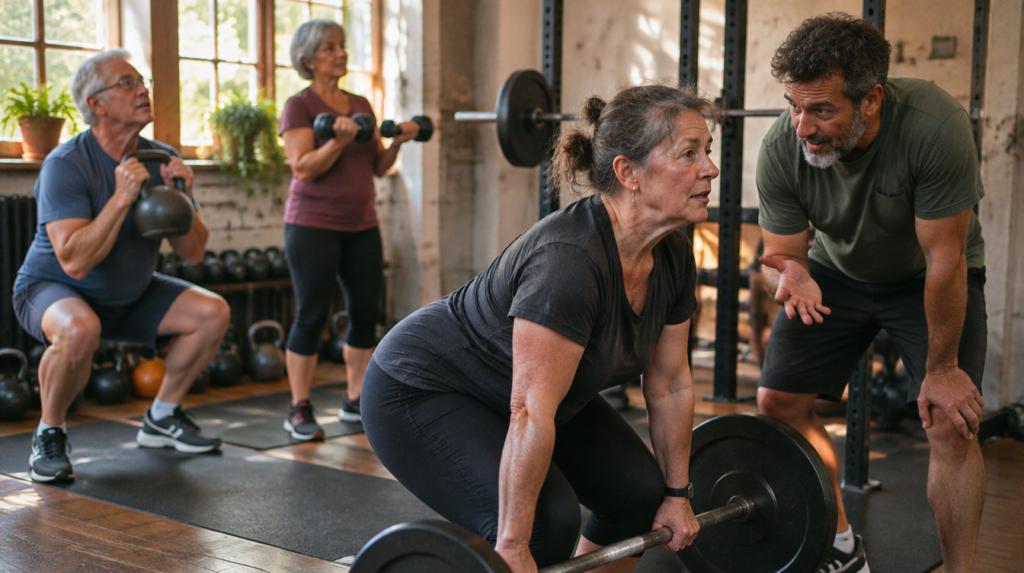
They should watch you move and ask about your history first. If someone puts a barbell in your hands in the first ten minutes without seeing you squat, hinge, reach overhead, or get down to the floor and back up, they are guessing.
That first look has a name here. The Starting Point Session is the appointment itself, and the Starting Point Assessment is the movement screen plus body composition scan that happens inside it. The screen is not something you pass or fail. It is how we find out that your left hip does not rotate the way your right one does, so we stop writing programs for a body you do not have. Every good coach does some version of this. If the place you are considering does not, ask why and listen closely to the answer.
What do “personal trainer Coraopolis” searches actually show you?
Mostly directories, in-home training companies advertising for staff, and whichever businesses have been diligent about their listings. Search results rank web pages, not coaching, and the two are only loosely related.
So use the list for the one thing it is good at — telling you who is close enough that you will still go in February — then do the part the internet cannot. Walk in. Ten minutes in a gym at the hour you would train tells you more than an afternoon of reading reviews. Look at who is on the floor and whether anybody is coaching them. If everyone there is 25 and training alone with headphones on, that is a perfectly good gym. Just not for what you need.
Which certifications actually mean something?
Look for a certification from an NCCA-accredited organization — NSCA, ACSM, NASM and ACE are the ones you will see most often — plus current CPR and liability insurance. Ask to see them. Nobody who takes this seriously will be offended by the question.
Then ask the question that matters more: who else do you train who looks like me? A coach who spends every day with college athletes is not automatically wrong for a 62-year-old with a cranky shoulder, but they are working off-script and you will feel it. I hold a CSCS through the NSCA, and the letters are the floor rather than the ceiling. They prove somebody learned the physiology. They do not prove anybody has spent a decade watching ordinary adults figure out how to deadlift again.
Do the letters after a name beat real experience?
No, but their absence is a signal worth noticing. A certification shows someone did the work on the science; the years show they have seen a few hundred bodies that never read the textbook.
What should the room itself tell you?
Look at the equipment and ask whether it resembles anything you do in real life. You will not find a stack machine or a pulley tower anywhere in either of our studios, and that is a deliberate design decision rather than a budget one.
A machine fixes the path of the movement and asks your body to fit it, which teaches you almost nothing about standing up out of a low chair, carrying mulch across a driveway, or catching your balance on an icy step in January. Free weights and your own bodyweight let the program fit you instead, and they make you do the stabilizing work that is quietly the whole point. The trade-off is that they demand real coaching, which brings us to the next question.
How many people should be on the floor with you?
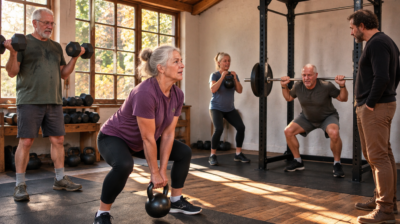
Few enough that the coach can see you. Our small group training sessions cap at eight people and average closer to four, with one coach on the floor and every person working their own program.
That last part is the one people assume I am exaggerating about. It is not a class. Nobody is at the front counting reps into a headset while twelve people do the same thing to the same music. You and the person on the next platform may be doing completely different work for completely different reasons, and the coach moves between you. Past a certain headcount, “personal training” quietly turns into supervision, and supervision is not what you are paying for.
What if you are coming out of physical therapy, or training around something?
Say so on the phone before you book. Some things need a doctor or physical therapist first, and a trainer who waves that away is the one to walk away from.
I have spent most of my career working alongside local chiropractors and physical therapists on what they call continuation of care — the stretch after your visits run out, when you have been discharged and told to keep moving, and nobody has explained what “keep moving” means on a Tuesday in your actual life. That handoff is where a lot of progress gets lost. A good coach will want to know who treated you and what they told you to avoid. If you are working around an old back, our post on how to lift safely after a back injury covers how we think about it.
How often should you actually be training?
Two days a week of real strength work is the baseline, not the ambitious version. The CDC’s physical activity guidelines for older adults call for muscle-strengthening work on at least two days a week, hitting all the major muscle groups, plus balance work on top of the walking most people already do.
I bring this up because it reframes the decision. You are not shopping for a trainer who can fill five days a week with something clever. You want someone who can make two sessions count and then get out of the way of the rest of your life.
What should the first visit cost you?
Nothing. The Starting Point Session is free, takes 45 minutes to an hour, and includes no workout and no sales pitch — you sit down, we talk, we screen how you move, and you leave knowing where you stand.
A $50 deposit holds your spot. It is credited toward your program if you start with us, and refunded if you decide we are not the right fit — that hour is a coach’s hour, blocked off and held for you. You can book a Starting Point Session in Coraopolis or book one at our Lawrence studio directly. And if you walk out of that hour and decide we are not your place, I would rather you take the movement screen results and go somewhere that is. That is cheaper for everyone than six months of you not showing up.
Where are you, and which towns do you serve?
We have two studios. The Coraopolis studio sits on Mulberry Street in the airport corridor and serves Coraopolis, Moon Township, Robinson, Kennedy Township, Neville Island, Crescent and Sewickley.
Our second studio is in Lawrence, on Commerce Boulevard, covering the southern end — Bridgeville, Canonsburg, South Fayette, Peters Township and Upper St. Clair. Both rooms run the same way, same equipment philosophy, same caps on group size, and you can find hours and directions for both on our locations page. If the drive to one is fifteen minutes shorter, take the shorter one. Proximity might be the largest factor in whether this works at all.
Choosing well is mostly a matter of asking these questions out loud and watching how comfortably they get answered. The coaching, the screening, the size of the room — you can verify all of it in an hour, standing in the building, before you spend a dollar.
Keep reading
- Small Group Personal Training in Coraopolis, PA — what a session looks like, start to finish.
- Strength Training After 50 — what changes and what to stop worrying about.
- How to Keep Training Through the Holidays — the six weeks that undo most people’s year.